How VAR Is Changing the Modern Game: Accuracy, Controversy, and the Future of Football Officiating
Few innovations in football history have sparked as much debate as the Video Assistant Referee. Introduced to eliminate clear and obvious errors, VAR has instead become a lightning rod for frustration, admiration, and genuine philosophical disagreement about what the sport should be. The technology works. The arguments haven't stopped. That tension is exactly what makes it worth examining closely.
What Is VAR and How Does It Work?
VAR is a match officiating system in which a team of video assistants reviews footage of key incidents and communicates with the on-field referee via earpiece. It was formally approved by IFAB (International Football Association Board) in 2018 and has since been deployed across the Premier League, Champions League, FIFA World Cup, and dozens of other competitions worldwide.
The VAR team operates from a video operations room — sometimes on-site, sometimes in a centralized hub — with access to multiple camera angles and replay speeds. They don't override the referee automatically. Instead, they flag potential errors in specific categories and either advise the referee directly or recommend an on-field review (OFR), where the referee watches the footage at a pitchside monitor before making a final call.
The system was designed with a deliberate threshold: VAR only intervenes for clear and obvious errors or serious missed incidents. In practice, defining those thresholds has proven far more complicated than the rulebook suggests.
The Four Match-Changing Decisions VAR Covers
VAR reviews four categories of incident, and only four. Goals, penalty decisions, red cards, and cases of mistaken identity — nothing else falls within its scope.
- Goals: Any goal can be checked for fouls, offside, or handball in the build-up. This has led to goals being disallowed minutes after celebrations began.
- Penalty decisions: Both the award and the denial of a penalty can be reviewed. A foul missed by the referee in real time can become a spot kick after VAR intervention.
- Red cards: Straight red card decisions — violent conduct, serious foul play — are reviewable. Yellow cards are not.
- Mistaken identity: If the wrong player is sent off or booked, VAR can correct the error.
The real-world impact of these four categories is significant. Research from the Premier League's early VAR seasons showed that the accuracy of match-changing decisions improved from roughly 82% to over 94%. But accuracy alone doesn't tell the whole story — a technically correct decision delivered poorly still damages trust in the system.
Offside Calls and the Rise of Semi-Automated Technology
Offside is where VAR has generated the most controversy, and the most visible technological evolution. The original VAR offside process involved manually drawing lines on freeze-frame images to determine whether a shoulder, armpit, or toe was beyond the last defender. Those lines took time, and the margins were sometimes measured in centimeters that no human eye could detect in real time.
The FIFA World Cup 2022 in Qatar introduced semi-automated offside technology as a direct response to these problems. The system uses dedicated cameras tracking player skeleton data — 29 body points per player, 50 times per second — combined with ball-tracking sensors to generate automated offside lines in seconds rather than minutes.
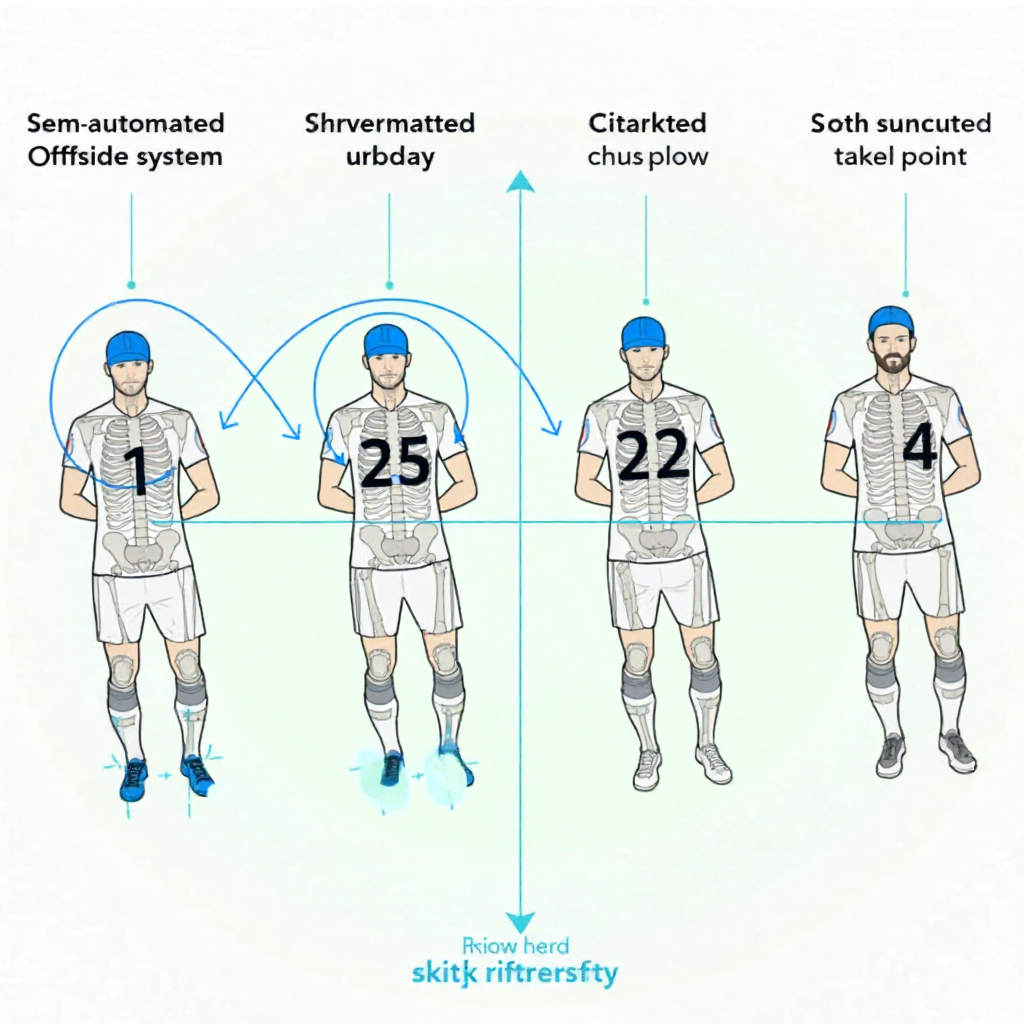
The Premier League adopted its own version of this system from the 2024/25 season onward, with the explicit goal of reducing the time fans spend waiting for offside decisions. Early results have been encouraging: average offside review times dropped substantially, and the visual output — a 3D animation shown on stadium screens — gives fans something concrete to look at rather than staring at a blank scoreboard.
The underlying tension hasn't disappeared, though. A player ruled offside by a toenail is still offside by the letter of the law. Whether that law serves the spirit of the game is a separate question that technology alone can't answer.
How VAR Is Reshaping Tactics and Player Behavior
Managers and players have adapted to VAR in ways that weren't fully anticipated when the system launched. Knowing that every incident in the penalty area will be scrutinized has changed how defenders position themselves and how attackers go to ground.
Defensive lines have pushed higher across elite football. If offside is going to be called with centimeter precision, there's less risk in holding a tight line — the technology will catch attackers who drift beyond it. Teams like Manchester City and Arsenal under recent managers have refined high-line defensive structures partly because VAR provides a safety net that wasn't there before.
Tactical adaptation extends to attacking play too. Strikers have become more cautious about holding off defenders in the box, aware that a slight lean or arm extension could result in a penalty being overturned. Some coaches now specifically train players on body positioning during aerial duels and penalty area challenges — not for football reasons, but for VAR reasons.
The handball rule has been a particular flashpoint. Its evolving interpretation — whether a handball is accidental, whether the arm is in a "natural" position — has created genuine confusion among players who no longer know exactly what the rules permit in a crowded penalty area.
The Fan Experience: Atmosphere, Delays, and the Celebration Problem
VAR's most visible cultural impact is on the goal celebration. Scoring a goal is one of football's purest moments — and VAR has made fans hesitant to fully commit to it. The image of supporters standing with arms half-raised, waiting to see whether the goal will stand, has become a defining visual of the modern game.
Stadium atmosphere suffers during lengthy reviews. The noise drops, the momentum drains, and by the time a decision is confirmed, the emotional peak has passed. For clubs selling the matchday experience as a premium product, this is a genuine commercial and cultural problem.
Delays vary widely. A straightforward goal check might take 90 seconds. A complex penalty and red card review can run past four minutes. The lack of in-stadium communication during reviews — fans often don't know what's being reviewed or why — compounds the frustration. Several leagues have experimented with public address announcements and stadium screen explanations, with mixed results.
Away from the stadium, the television experience is different. Broadcasters fill review time with replays and expert commentary, which arguably makes VAR more tolerable for viewers at home than for supporters in the ground.
Criticism, Controversy, and the Case Against VAR
The strongest criticisms of VAR aren't really about the technology — they're about consistency, subjectivity, and the erosion of spontaneity. These are legitimate concerns that deserve a fair hearing.
Inconsistency between competitions is a real problem. The same incident — a handball, a challenge from behind — can result in different outcomes in the Premier League versus the Champions League versus a domestic cup competition, because different VAR teams apply the same rules with different thresholds. This inconsistency undermines the core promise of the system: that it makes decisions more fair and uniform.
Subjective rulings haven't gone away. Whether a foul is a red card or a yellow, whether contact in the box constitutes a penalty — these judgments still depend on interpretation. VAR can slow the process down and add more eyes to it, but it can't remove human judgment from decisions that are inherently judgment calls.
There's also the time disruption argument. Football is a flowing, continuous sport. Stopping play for multiple minutes several times per match changes the rhythm of the game in ways that go beyond the specific incidents reviewed. Some football analysts argue that VAR has contributed to a more stop-start, cautious style of play at the highest level — though separating VAR's influence from other tactical trends is genuinely difficult.
Where VAR Goes From Here: Improvements and What Leagues Are Doing
VAR is not going away, but it is evolving — and several leagues are actively working to address its most persistent problems. The direction of travel is toward faster decisions, better communication, and more consistent application.
The Premier League's adoption of semi-automated offside technology is the most significant recent reform. The IFAB continues to review the handball rule and the precise definition of "clear and obvious error" with the goal of narrowing interpretive gaps between competitions.
Communication transparency is an emerging priority. Some competitions have begun experimenting with broadcasting referee audio during reviews — a practice already normalized in rugby union, where referee communication with the television match official is part of the broadcast. Football's governing bodies have been slower to embrace this, citing privacy and competitive concerns, but fan pressure is building.
Longer term, the integration of artificial intelligence into real-time decision support — not just offside, but foul detection and ball-tracking — is being explored at research level. The goal is a system that provides instant, visually clear, and consistently applied decisions without the delays that currently frustrate supporters.
Whether that future version of VAR will feel like football is the question nobody has fully answered yet.
Frequently Asked Questions About VAR
Which football competitions currently use VAR?
VAR is used in the FIFA World Cup, UEFA Champions League, UEFA Europa League, Premier League, La Liga, Serie A, Bundesliga, Ligue 1, and many other top-tier domestic and international competitions. Lower divisions and some national cups still operate without it due to cost and infrastructure requirements.
Can VAR decisions be appealed by managers or clubs?
No. There is no formal appeal mechanism within a match. Clubs can file post-match complaints to their governing body, but VAR decisions are final during play. This is one of the system's most criticized limitations, particularly when errors are later acknowledged publicly.
Why does VAR still produce controversial or incorrect decisions?
Because many football decisions are inherently subjective. VAR improves accuracy on factual questions — was the ball over the line, was the player offside — but it can't eliminate disagreement on judgment calls like the severity of a challenge or the intent behind a handball.
How long does a typical VAR review take?
Simple checks, like a routine offside review using semi-automated technology, can be completed in under 60 seconds. Complex reviews involving multiple angles and judgment calls — a potential red card combined with a penalty decision — can take three to five minutes. The average across all review types in recent Premier League seasons has been approximately 90 seconds.
What is the difference between VAR and goal-line technology?
Goal-line technology is a separate, automated system that uses cameras or magnetic sensors to determine instantly whether the ball has crossed the goal line. It produces a binary yes/no result with no human review involved. VAR is broader in scope and requires human judgment. Both systems can operate simultaneously — goal-line technology handles its specific question automatically, while VAR covers the four reviewable incident categories.