The Evolution of Football Formations Over the Decades
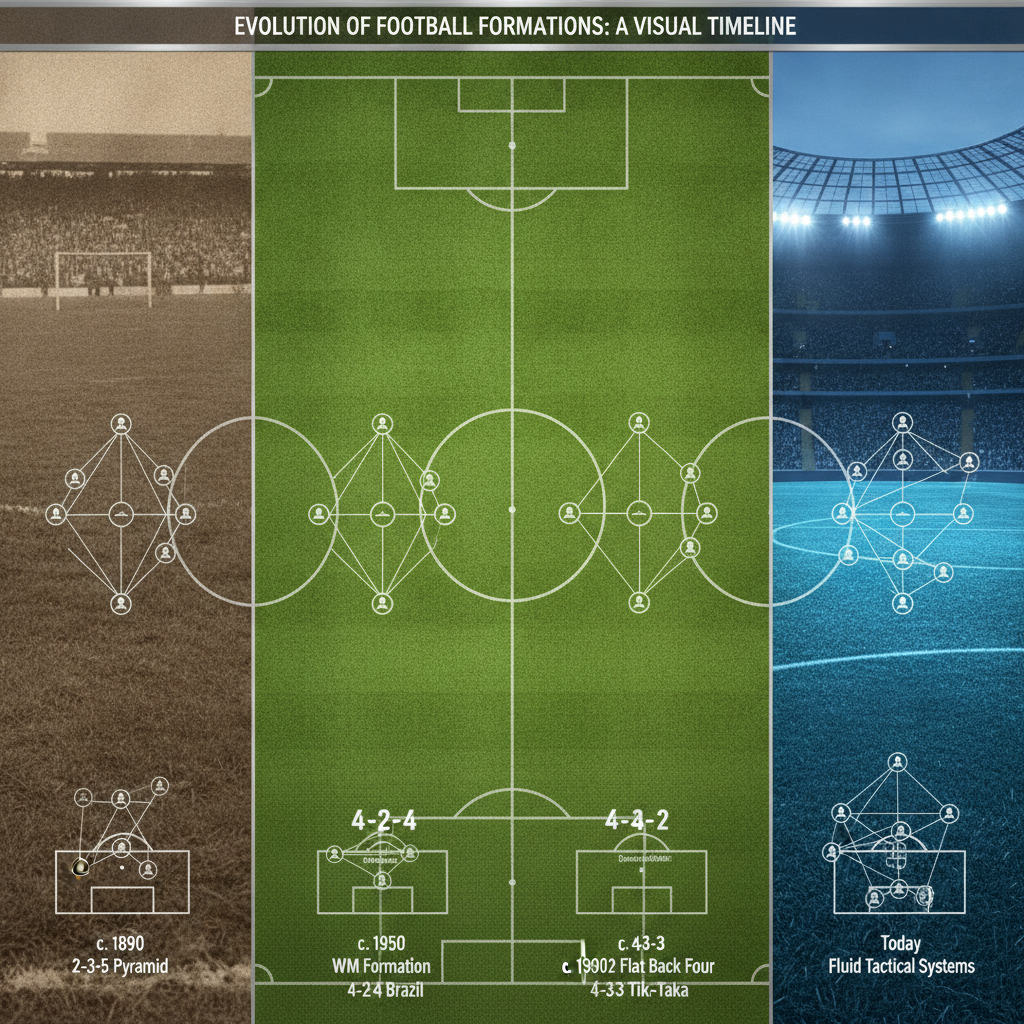
Football formations reveal how teams understand space. They influence where players begin, how attacks develop, which passing lanes remain open, and how a side protects itself after losing possession. From the attack-heavy 2-3-5 formation to today’s flexible 4-2-3-1, the history of football tactics reflects changes in laws, athletic demands, coaching ideas, and match analysis.
Why Football Formations Matter
Football formations are starting structures that organize spacing, player responsibilities, pressing, build-up play, and defensive coverage. They provide a reference point before the match begins, although the actual shape often changes when a team has or loses the ball.
A formation answers practical questions. How many players support the first line of pressure? Who protects the centre? Where does a team create width? Which player covers a full-back when that defender attacks? These details matter more than the numbers printed beside a team’s name.
For example, a nominal 4-3-3 may become a 3-2-5 during possession if one full-back moves into midfield and the other stays deeper. Out of possession, it may return to a compact 4-1-4-1. The diagram describes the initial arrangement; the tactical framework describes the team’s behaviour.
Formation analysis works best across three phases:
- In possession: how the team builds attacks, creates width, and occupies the opposition’s defensive line.
- Out of possession: how it presses, blocks passing lanes, and protects central areas.
- Transition: how quickly players attack space or recover defensive positions after a turnover.
This is why the same formation can produce very different football. A 4-4-2 built around a high press behaves differently from a deep, counterattacking 4-4-2.
Early Football Systems: From 2-3-5 to the WM Formation
The 2-3-5 formation was an early dominant system, while the WM formation introduced greater defensive balance through deeper marking and clearer positional structure. This transition reflected the need to respond to tactical changes and the evolving interpretation of the offside law.
The 2-3-5, often called the pyramid, placed two full-backs behind a three-man midfield line and five attackers ahead of them. The system naturally emphasized forward play. Wingers stretched the pitch, inside forwards linked midfield with the front line, and the centre-forward led attacks through the middle.
Its strength was numerical presence in the attacking half. Its weakness was the space left behind the midfield, especially when opponents circulated the ball quickly or counterattacked through the centre.
The WM formation reorganized the same basic resources into a shape resembling the letters W and M. Two half-backs moved into more defensive roles, while a centre-half dropped deeper to track the opposing centre-forward. This created a back three in defensive terms and a more staggered attacking structure ahead of it.
The change was significant for match analysis because it made marking assignments more explicit. Instead of relying on a broad line of midfielders, the WM system created clearer defensive matchups and improved protection around the penalty area. It also demonstrated an enduring tactical principle: when a rule or opponent creates new space, teams alter their structure to control it.
Early formations were therefore more than historical curiosities. They established the foundations of modern concepts such as defensive cover, positional balance, and the separation of attacking and defensive responsibilities.
The Rise of Structured Attacking Formations
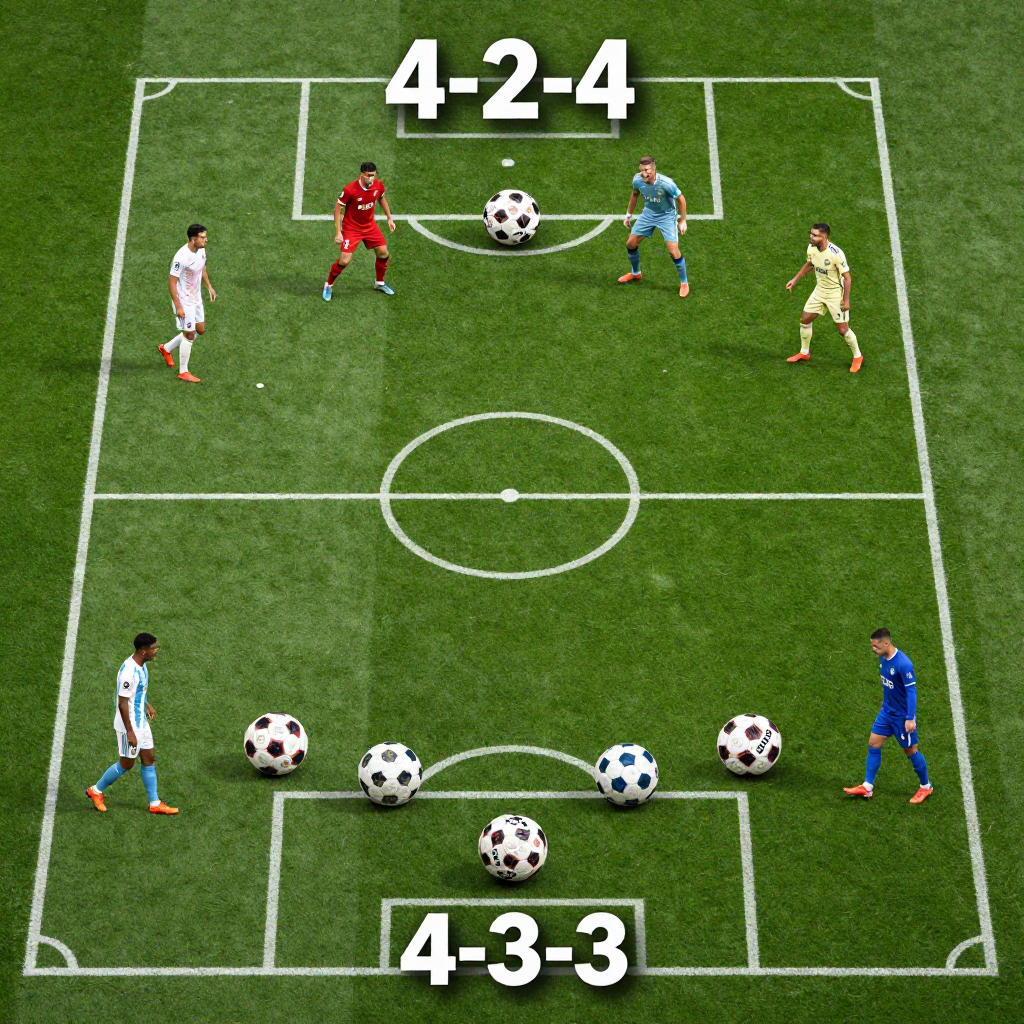
The 4-2-4 formation restored attacking emphasis with four forwards, while the 4-3-3 added midfield support and made width easier to control. Both systems helped teams attack with clear spacing, but they demanded disciplined movement behind the ball.
The 4-2-4 placed two defenders, two midfielders, and four attackers in distinct lines. The wide forwards could stretch the opposition, while the central pair occupied defenders and attacked crosses or through-balls. With four players high up the pitch, teams could press defenders earlier and create immediate passing options after regaining possession.
Its major risk was midfield isolation. Two central midfielders had to cover large areas, particularly when the full-backs moved forward. Choosing the 4-2-4 for attacking numbers meant accepting a greater possibility of being outnumbered in the centre.
The 4-3-3 addressed that problem by adding a third midfielder without sacrificing natural width. Wingers held wide positions, the central striker occupied the back line, and the midfield triangle supported circulation, pressing, and defensive recovery. The shape also allowed one midfielder to operate as a defensive midfielder, protecting the centre while the other two advanced.
Compared with the 4-2-4, the 4-3-3 offered stronger control of second balls and better defensive coverage. However, its wide attackers needed to track opposing full-backs, and the lone striker could become isolated if the midfield failed to advance.
When analyzing these systems, observe the distance between the midfield and forwards. A compact 4-3-3 can dominate territory; a stretched version may look like a 4-2-4 without the same attacking coordination.
The Dominance and Adaptation of 4-4-2
The 4-4-2 became popular because it offered simple defensive organization, midfield balance, natural width, and a clear strike partnership. Its two banks of four were easy to coach and gave teams reliable reference points during pressing and defensive recovery.
In a traditional 4-4-2, the wide midfielders supported the full-backs, the central midfielders protected the space between the lines, and two strikers shared the forward line. One striker might run beyond the defence while the other dropped toward midfield or challenged for aerial balls.
The system worked especially well when the team maintained short distances. The first striker could direct play toward one side, the midfield line could shift across, and the second striker could help block passes into the opposition’s defensive midfielder.
Its weaknesses became clearer against teams that created an extra central midfielder. A 4-3-3 or 4-2-3-1 could place three players against the 4-4-2’s central pair, forcing one striker to drop or one midfielder to leave the defensive line. The space behind the wide midfielders also became vulnerable when opponents used overlapping full-backs.
Coaches adapted the shape in several ways. A wide midfielder could move inside to create a narrow diamond. One striker could drop into a number 10 role, producing a 4-4-1-1. Alternatively, the team could defend in 4-4-2 while building in a different structure.
The lesson is useful beyond this particular era: a formation remains effective when its players can protect its weak zones. The 4-4-2 was not automatically superior. It was dependable because it gave players clear tasks and manageable distances.
The Growth of Midfield Control and Back-Three Systems
The 3-5-2 formation increased central numbers and used wing-backs to provide width, defensive cover, and forward running. Its success depends on coordinated movement because the wing-backs must contribute in both halves of the pitch.
Three central defenders give the team protection against two-striker attacks and create passing angles during build-up. In midfield, three central players can outnumber a pair, while two forwards occupy defenders and combine through the middle.
The wing-back role is the system’s defining feature. A wing-back is neither a conventional full-back nor a pure winger. In possession, the player may stand high and wide, attack the outside channel, or move inside to support midfield. Out of possession, the same player must recover alongside the back three and defend the flank.
That flexibility creates advantages but also costs. If both wing-backs advance simultaneously and possession is lost, the outside centre-backs may be pulled into wide areas. Quick opponents can then attack the space behind them. Teams usually reduce this risk by keeping a defensive midfielder deeper or staggering the wing-backs’ movements.
Back-three systems can also create central overloads. A team may use the outside centre-backs to carry the ball forward, draw out a pressing opponent, and release a wing-back or striker. Against a narrow block, this can open routes around the outside. Against a side with aggressive wide pressing, the build-up may become predictable.
Watching the wing-backs is often the fastest way to identify whether a 3-5-2 is functioning. Their average position, recovery speed, and relationship with the outside centre-backs reveal more than the lineup graphic.
Modern Football: Formations as Fluid Tactical Frameworks
Modern football formations are fluid frameworks that change between possession, pressing, and defensive phases. Systems such as the 4-2-3-1 give coaches a stable starting point while allowing players to rotate into different attacking and defensive shapes.
The 4-2-3-1 usually contains two deeper midfielders, three attacking midfielders, and one striker. The double pivot supports circulation and protects central areas, while the number 10 receives between the opposition’s midfield and defence. Wide attackers can hold the touchline, attack inside, or press opposing full-backs.
In possession, the structure may become a 2-3-5 if both full-backs push high and the defensive midfielder drops between the centre-backs. During a high press, it can resemble a 4-4-2, with the number 10 joining the striker. In a deep block, the wide attackers may retreat to form a compact midfield four.
This phase-based view helps explain why **tactical flexibility** has become so important. Players must recognize triggers rather than stand permanently in fixed zones. A full-back may underlap, a winger may become a second striker, and a defensive midfielder may drop into the back line for several possessions.
The trade-off is complexity. Fluid systems can create superior passing angles, but they require shared timing and strong communication. If one player rotates without adequate cover, the team may lose rest defence, the structure that protects against counterattacks.
For reliable definitions of historical systems and tactical terminology, analysts can compare specialist observations with the broader reference material available through football formation records.
How to Analyze Formation Changes During a Match
To analyze formation changes during a match, compare the team’s positions in possession, out of possession, and immediately after turnovers. Focus on repeated movements rather than one isolated attack or a temporary defensive scramble.
1. Establish the starting reference
Identify the opening lineup and note the nominal formation. Then check whether the full-backs begin level with the centre-backs, whether a midfielder drops into the first line, and whether the wingers stay wide.
2. Track the defensive shape
When the opponent has the ball, count the lines and central players. A 4-2-3-1 may become 4-4-2 if the number 10 steps alongside the striker. A 3-5-2 may defend as 5-3-2 when the wing-backs recover.
3. Watch pressing triggers
Look for backward passes, poor first touches, passes toward the touchline, or slow circulation across the back line. These moments often reveal whether a team presses with two, three, or four players in the first wave.
4. Follow full-back and wing-back positioning
Their height can expose the team’s attacking plan. A full-back staying deep may protect against counters, while an advanced wing-back signals an intention to pin the opposition’s wide defender.
5. Check substitutions and role changes
A substitution may change the formation without changing the number of defenders. A winger replacing a midfielder can create a 4-3-3; a centre-back entering for a wide attacker may produce a back three with wing-backs.
6. Measure the consequences
Ask what the change created and what it conceded. Did the team gain an extra player between the lines? Did it lose protection behind an advancing full-back? This final step separates formation description from genuine match analysis.
Common analytical mistakes include treating the broadcast graphic as permanent, naming a formation from one moment, and ignoring player distances. A better approach records recurring patterns over several phases of play. Formations are clues; movement, spacing, and decision-making explain the match.
Frequently Asked Questions About Football Formations
Which football formation was used before the modern 4-4-2?
The 2-3-5 formation was widely used before later systems such as the WM, 4-2-4, and 4-4-2. The WM formation then introduced a more balanced defensive structure.
Why did 4-4-2 become so popular?
The 4-4-2 offered clear defensive lines, natural width, two central midfielders, and a straightforward strike partnership. Its simplicity made it adaptable, although it could be outnumbered in midfield.
What is the difference between a 4-3-3 and a 4-2-3-1?
A 4-3-3 normally uses three midfielders behind three forwards, while a 4-2-3-1 uses a double pivot, a number 10, two wide attackers, and one striker. Both can change shape during different phases.
Why do teams use wing-backs in a back-three system?
Wing-backs provide width in attack and recover to form a back five in defence. Their two-way role gives a back-three system additional central cover without sacrificing wide progression.
Are modern football formations fixed throughout a match?
No. Modern formations usually change according to possession, pressing instructions, transitions, substitutions, and the scoreline. The nominal formation is best understood as the team’s starting reference.